"My Dear Wormwood,
"I note with grave displeasure that your patient has become a Christian. Do not indulge the hope that you will escape the usual penalties; indeed, in your better moments, I trust you would hardly even wish to do so. In the meantime we must make the best of the situation. There is no need to despair; hundreds of these adult converts have been reclaimed after a brief sojourn in the Enemy's camp and are now with us. All the habits of the patient, both mental and bodily, are still in our favour."
Under this delusive hope, professional devil Screwtape begins a series of letters to his nephew, a learning devil, Wormwood, on how to tempt and snare a human soul away from God. A nameless young man comes to Christ for salvation, and Screwtape passes on his "expert" advice to Wormwood, teaching him to distract him from God by means of tension in the family, issues and divisions in the church, romantic interests, flippancy about spiritual matters, obsession with the Future or the Past, and so on. He is convinced that they will prevail in the end over the work of God in the young Christian... but can they?
There is no doubt Clive Staples Lewis has become one of my most favorite authors in the last year. This is not to say I agree with every point he makes, but overall his writings are so insightful, and his use of fantasy and speculative fiction to make such strong, valid Biblical points never ceases to amaze me. In The Screwtape Letters, Lewis presents truth by the way of contrast. The devil tempts the young man to do this or to think this way, in contrast to this or that which would bring glory to God. In Lewis' preface, he reminds his readers that "the devil is a liar. Not everything that Screwtape says should be assumed to be true even from his own angle." In a later preface, someone explains it thus: "Screwtape's whites are our blacks and whatever he welcomes we should dread." I found it very interesting and insightful, and it also helped to give me a fresh perspective on many things. It's worth reading all the way to the end--despite it's being written from the perspective of a devil (wallowing in his defeat), the last chapter was so beautiful, it brought tears to my eyes... but I can't tell you why. You'll have to read it for yourself. :-)
As I was reading the book, I wanted to re-post almost every chapter when I finished it, so even now I'm having a hard time deciding which excerpt to post for you. I will share the excerpt I first read that made me want to pick up the book, and one chapter that particularly stood out to me as I read.
~~~~~~~~
Chapter XV
MY DEAR WORMWOOD,
I had noticed, of course, that the humans were having a lull in their European war—what they naïvely call "The War"!—and am not surprised that there is a corresponding lull in the patient's anxieties. Do we want to encourage this, or to keep him worried? Tortured fear and stupid confidence are both desirable states of mind. Our choice between them raises important questions.
The humans live in time but our Enemy destines them to eternity. He therefore, I believe, wants them to attend chiefly to two things, to eternity itself, and to that point of time which they call the Present. For the Present is the point at which time touches eternity. Of the present moment, and of it only, humans have an experience analogous to the experience which our Enemy has of reality as a whole; in it alone freedom and actuality are offered them. He would therefore have them continually concerned either with eternity (which means being
concerned with Him) or with the Present—either meditating on their eternal union with, or separation from, Himself, or else obeying the present voice of conscience, bearing the present cross, receiving the present grace, giving thanks for the present pleasure.
Our business is to get them away from the eternal, and from the Present. With this in view, we sometimes tempt a human (say a widow or a scholar) to live in the Past. But this is of limited value, for they have some real knowledge of the past and it has a determinate nature and, to that extent, resembles eternity. It is far better to make them live in the Future. Biological necessity makes all their passions point in that direction already, so that thought about the Future inflames hope and fear. Also, it is unknown to them, so that in making them think about it we make them think of unrealities. In a word, the Future is, of all things, the thing least like eternity. It is the most completely temporal part of time—for the Past is frozen and no longer flows, and the Present is all lit up with eternal rays. Hence the encouragement we have given to all those schemes of thought such as Creative Evolution, Scientific Humanism, or Communism, which fix men's affections on the Future, on the very core of temporality. Hence nearly all vices are rooted in the future. Gratitude looks to
the past and love to the present; fear, avarice, lust, and ambition look ahead. Do not think lust an exception. When the present pleasure arrives, the sin (which alone interests us) is already over. The pleasure is just the part of the process which we regret and would exclude if we could do so without losing the sin; it is the part contributed by the Enemy, and therefore experienced in a Present. The sin, which is our contribution, looked forward.
To be sure, the Enemy wants men to think of the Future too—just so much as is necessary for now planning the acts of justice or charity which will probably be their duty tomorrow. The duty of planning the morrow's work is today's duty; though its material is borrowed from the future, the duty, like all duties, is in the Present. This is not straw splitting. He does not want men to give the Future their hearts, to place their treasure in it. We do. His ideal is a man who, having worked all day for the good of posterity (if that is his vocation),
washes his mind of the whole subject, commits the issue to Heaven, and returns at once to the patience or gratitude demanded by the moment that is passing over him. But we want a man hag-ridden by the Future—haunted by visions of an imminent heaven or hell upon earth—ready to break the Enemy's commands in the
present if by so doing we make him think he can attain the one or avert the other—dependent for his faith on the success or failure of schemes whose end he will not live to see. We want a whole race perpetually in pursuit of the rainbow's end, never honest, nor kind, nor happy now, but always using as mere fuel wherewith to heap the altar of the future every real gift which is offered them in the Present.
It follows then, in general, and other things being equal, that it is better for your patient to be filled with anxiety or hope (it doesn't much matter which) about this war than for him to be living in the present. But the phrase "living in the present" is ambiguous. It may describe a process which is really just as much concerned with the Future as anxiety itself. Your man may be untroubled about the Future, not because he is concerned with the Present, but because he has persuaded himself that the Future is, going to be agreeable. As long as that
is the real course of his tranquillity, his tranquillity will do us good, because it is only piling up more disappointment, and therefore more impatience, for him when his false hopes are dashed. If, on the other hand, he is aware that horrors may be in store for him and is praying for the virtues, wherewith to
meet them, and meanwhile concerning himself with the Present because there, and there alone, all duty, all grace, all knowledge, and all pleasure dwell, his state is very undesirable and should be attacked at once. Here again, our Philological Arm has done good work; try the word "complacency" on him. But, of course, it is most likely that he is "living in the Present" for none of these reasons but simply because his health is good and he is enjoying his work. The phenomenon would then be merely natural. All the same, I should break it up if I were you. No natural phenomenon is really in our favour. And anyway, why should the creature be happy?
Your affectionate uncle
SCREWTAPE
~~~~~~~~
Chapter XXVII
MY DEAR WORMWOOD,
You seem to be doing very little good at present. The use of his "love" to distract his mind from the Enemy is, of course, obvious, but you reveal what poor use you are making of it when you say that the whole question of distraction and the wandering mind has now become one of the chief subjects of his prayers. That means you have largely failed. When this, or any other distraction, crosses his mind you ought to encourage him to thrust it away by sheer will power and to try to continue the normal prayer as if nothing had happened; once he accepts the distraction as his present problem and lays that before the Enemy and makes it the main theme of his prayers and his endeavours, then, so far from doing good, you have done harm. Anything, even a sin, which has the total effect of moving him close up to the Enemy, makes against us in the long run.
A promising line is the following. Now that he is in love, a new idea of earthly happiness has arisen in his mind: and hence a new urgency in his purely petitionary prayers—about this war and other such matters. Now is the time for raising intellectual difficulties about prayer of that sort. False spirituality is always to be encouraged. On the seemingly pious ground that "praise and communion with God is the true prayer", humans can often be lured into direct disobedience to the Enemy who (in His usual flat, commonplace, uninteresting way) has definitely told them to pray for their daily bread and the recovery of their sick. You will, of course, conceal from him the fact that the prayer for daily bread, interpreted in a "spiritual sense", is really just as crudely
petitionary as it is in any other sense.
But since your patient has contracted the terrible habit of obedience, he will probably continue such "crude" prayers whatever you do. But you can worry him with the haunting suspicion that the practice is absurd and can have no objective result. Don't forget to use the "heads I win, tails you lose" argument. If the thing he prays for doesn't happen, then that is one more proof that petitionary prayers don't work; if it does happen, he will, of course, be able to see some of the physical causes which led up to it, and "therefore it would have happened anyway", and thus a granted prayer becomes just as good a proof as a denied one that prayers are ineffective.
You, being a spirit, will find it difficult to understand how he gets into this confusion. But you must remember that he takes Time for an ultimate reality. He supposes that the Enemy, like himself, sees some things as present, remembers others as past, and anticipates others as future; or even if he believes that the Enemy does not see things that way, yet, in his heart of hearts, he regards this as a peculiarity of the Enemy's mode of perception—he doesn't really think (though he would say he did) that things as the Enemy sees them are things as they are! If you tried to explain to him that men's prayers today are one of the innumerable coordinates with which the Enemy harmonises the weather of tomorrow, he would reply that then the Enemy always knew men were going to make those prayers and, if so, they did not pray freely but were predestined to do so. And he would add that the weather on a given day can be traced back through its causes to the original creation of matter itself—so that the whole thing, both on the human and on the material side, is given "from the word go". What he ought to say, of course, is obvious to us; that the problem of adapting the
particular weather to the particular prayers is merely the appearance, at two points in his temporal mode of perception, of the total problem of adapting the whole spiritual universe to the whole corporeal universe; that creation in its entirety operates at every point of space and time, or rather that their kind of consciousness forces them to encounter the whole, self-consistent creative act as a series of successive events. Why that creative act leaves room for their free will is the problem of problems, the secret behind the Enemy's nonsense
about "Love". How it does so is no problem at all; for the Enemy does not foresee the humans making their free contributions in a future, but sees them doing so in His unbounded Now. And obviously to watch a man doing something is not to make him do it.
It may be replied that some meddlesome human writers, notably Boethius, have let this secret out. But in the intellectual climate which we have at last succeeded in producing throughout Western Europe, you needn't bother about that. Only the learned read old books and we have now so dealt with the learned that they are
of all men the least likely to acquire wisdom by doing so. We have done this by inculcating The Historical Point of View. The Historical Point of View, put briefly, means that when a learned man is presented with any statement in an ancient author, the one question he never asks is whether it is true. He asks who influenced the ancient writer, and how far the statement is consistent with what he said in other books, and what phase in the writer's development, or in the general history of thought, it illustrates, and how it affected later writers, and how often it has been misunderstood (specially by the learned man's own colleagues) and what the general course of criticism on it has been for the last ten years, and what is the "present state of the question". To regard the ancient writer as a possible source of knowledge—to anticipate that what he said could possibly modify your thoughts or your behaviour—this would be rejected as unutterably simple-minded. And since we cannot deceive the whole human race all the time, it is most important thus to cut every generation off from all others; for where learning makes a free commerce between the ages there is always the danger that the characteristic errors of one may be corrected by the characteristic truths of another. But thanks be to our Father and the Historical Point of View, great scholars are now as little nourished by the past as the most ignorant mechanic who holds that "history is bunk",
Your affectionate uncle
SCREWTAPE
Showing posts with label book reviews. Show all posts
Showing posts with label book reviews. Show all posts
Tuesday, February 8, 2011


Friday, October 22, 2010
Our Mutual Friend

Dickens’ last novel, and one of his most complex and unique plots, finds its beginnings with a man named Harmon. Harmon was a hard, greedy, and unfeeling man who gained a great fortune in dust mounds. Upon his death, his inheritance is to go to his son John, who has been living abroad for most of his life, on the condition that he marries a woman whom he has never met—one Bella Wilfer. However, at the time that young John Harmon was to return to claim his fortune and his bride, he is reported drowned.
At this unexpected turn of events, the Harmon fortune goes to Mr. Harmon’s most trusted servants, Mr. and Mrs. Nicodemus Boffin, while various people become suspect for the murder of the drowned man. Happy-go-lucky, endearing, and unspoiled Mr. and Mrs. Boffin decide to “go in for fashion” and take in John Harmon’s intended bride, beautiful but mercenary Bella, to help soften the injury at being willed “like a dozen spoons” and at losing a prospective fortune. Joining the Boffins to act as a secretary is a mysterious man called John Rokesmith, who appears to have no back history but who studies Bella quietly and faithfully.
At the same time, a carefree, idle young laywer named Eugene Wrayburn makes attempts to clear Gaffer Hexam, the man who recovered the body of John Harmon, of the suspicion of having done the murderous deed. Not only does he wish to clear Gaffer, but he also finds himself attracted to the man’s modest and gentle daughter Lizzie. He is not the only man attracted to Lizzie’s beauty and sweet temperament; the girl also finds herself followed by her brother’s somewhat psychotic schoolmaster.
In his masterful way, Dickens weaves together a tale so complex and so compelling, and at the same time packed with rich spiritual truths, and all of it finding its center in the “mutual friend” of the title. Approximately 800 pages of reading will sweep you up into a tale consisting of sweet romance, murder mystery, stalkers, the painted lives of high society and the stark realities of riverside London, wealth and poverty, disputed wills, midnight chases, and a vast array of unique characters (some totally loveable and some absolutely detestable).
Not only does Our Mutual Friend commentate on the social ills of the day, but it also portrays a variety of Biblical truths that leap right off the page into the very lives of the readers. In this story, we see parallels of Christ's relation to the Church (how He draws us and proves us through testing), of faith and trust. We see the difference between selfishness and contentment, between false love that seeks to gain for oneself and true love that wishes the good for others. We see the mind of the redeemed, and we see the mind of a murderer. We see the false expectations of the world and the heart of what truly matters. Our Mutual Friend gives its readers much to think on and apply.
Our Mutual Friend is, at this point, my favorite Dickens novel (and miniseries), and I highly recommend it! However, it may not be enjoyable to those who enjoy an easy read, a simple plot, light comedy, and few enough characters to keep track of easily. Dickens was a writer with a master mind, and reading any book by him is no small undertaking. However, it is both enjoyable and rewarding.
Thursday, September 2, 2010
The Highlander's Last Song / What's Mine's Mine

Set in the rugged Scottish highlands in the mid-19th century, The Highlander's Last Song captures in print a crucial and life-changing era in the history of Scotland. For centuries, the hardy Scotsmen had clung to their land, working at the stubborn soil and keeping in close-knit clans. Then rich landowners from the south took notice of the region and of the wealth it could bring them. Impoverished clansmen and farmers were often expelled from their homes as the rich Southerners sought to use the land for their own gain, thus scattering the clans and changing the course of the highlanders' history.
Among those men seeking gain from the land in George MacDonald's novel is Peregrine Palmer, a selfish and mercenary man with two grown sons and four daughters. They have just moved to the region of Strathruadh and they find a culture and a people very unlike that which they are used to. Perhaps the most unusual people in their new acquaintance are the brothers Alistair and Ian-- Alistair in particular, because he is not only a Highlander, but he is also the chief of his clan. Alistair's great love for his land, his people, and his God manifests itself in his dealings with his clan as well as with the money-loving Palmer.
 The two oldest Palmer girls, Christina and Mercy, take an interest in the brothers at first because they find them handsome and interesting to be around, and the girls are used to flirting. However, they soon find that the young men are not to be swayed by good looks or playful flirtation; they have something the girls do not have and can hardly even imagine-- a living relationship with God. Together, the brothers share their heart for God, and slowly, the girls' eyes begin to open to the spiritual realities around them. At the same time, their hearts also begin to open to the stirrings of true love.
Mr. Palmer, however, is not interested in spiritual realities or love-- only in the land that can bring him wealth and prosperity. This selfish desire and inner pride kindles within him until an unexpected and pure-hearted move of Alistair's, coupled with conscience, cause it to burst into full flame. Palmer will stop at no ends to get what he wants, even if it means casting people out of their own homes and disrupting the clan life; he is fueled by the thought,"What's mine's mine!". As financial and personal troubles close in around Alistair, he comes to learn to depend not on earthly things but on God alone, who provides all good things and never loses sight of his children, and he must learn to say submissively to God, "What's mine is Yours."
Knowing little of the story, I let this book sit on our shelf for a couple years without picking it up, sitting down, and reading it. Once I did, however, I quickly found it not only to be a fantastic read, but also to rise among The Fisherman's Lady and The Curate's Awakening in the ranks of my absolute favorite MacDonald novels.
I found it one of the best-crafted plots I have read of George MacDonald's. While the spiritual message is very similar to The Laird's Inheritance, the whole storyline, as well as the characters' journeys, was much stronger and much more endearing to me. Unlike some of his books that peter out towards the end with no climax and leave the reader feeling somewhat depressed, this book built throughout to a sensational climax in both the outward circumstances and inner lives of the characters. Also, the spiritual journey and the actual plot ran alongside each other beautifully, rather than running like two separate streams which cross paths every so often (which I felt was the case in The Laird's Inheritance.) That made it seem much more real to me.

Another superior quality I found in this book was the character development. Sometimes MacDonald's protagonists end up being too much like each other, and sometimes the characters are either too good or too simple to seem real. In The Highlander's Last Song, the characters live. Alistair has a sincere and inspiring passion for God, but at the same time he is very human, and struggles with pride, anger, and dependence on material things. Through seeking God and through trials, he learns to turn things over to God, and his spiritual growth is evident throughout. Likewise, Christina and Mercy are very real, and their growth from spiritual "deadness" to a consciousness of and desire for God could be true for any person. Mr. Palmer is perhaps one of the most alarmingly realistic of all the characters: his apathy towards God, his resentment towards God-fearers, and the gangrene-like effect of selfishness in his life are a very true, but sad, reality in so many people today. All of these characters I grew to know and feel for; the good characters I came to love and cheer for, and the bad characters I felt, with the Highlanders, like charging and pummeling down and at least attempting to knock some sense into their heads.
Of course, rising above all these things, is the excellence of MacDonald's use of the pen to bring the message of true Christianity to the hearts of his readers. Throughout his writing, he frequently takes a pause to speak directly to the reader about their own spiritual need, or about some Biblical truth-- a practice which would cause many editors today to shake their head, the spiritually dead to sneer in disgust, and the seekers of God to bow their hearts and say "Amen". Treasure chests of spiritual wealth lie within the pages of this book, ready to be discovered, ready to change lives. MacDonald had not that painted-glass-window view of religion. His Christianity was real, and his protagonist's Christianity is real; he came as close as humans on earth can get to grasping the truth of knowing Christ-- as Alistair says to Mercy, "What is saving but taking us out of the dark into the light? There is no salvation but to know God and grow like Him."

MacDonald does not use theological arguments to try to convince his readers or his characters of things. He realized that no end of talk cannot change the life of a person not willing to be changed. One character speaking to another, says, "I will not try to convince you of anything about God. I cannot. You must know Him. I only tell you I believe in Him with all my heart. You must ask Him to explain Himself to you, and not take it for granted that He has done you a wrong because He has done what you do not like. Whether you seek Him or not, He will do you justice. But He cannot explain Himself unless you seek Him." The same can be true for you.
I definitely encourage you to take the time to read this book. It is no longer in print, but it can be found on Amazon.com and at used bookstores and thrift stores. You will find not only a gripping story and sweet, clean romance, but also a message that could change your life-- a soul-searching question: "Is my heart fully surrendered to whatever God has for me? Am I willing to let what is mine be His?"
Saturday, June 26, 2010
North and South

In a rather Pride-and-Prejudice sort of manner, Mr. Thornton develops a romantic interest in Margaret, who detests his ways of dealing with his workers and spurns him with her haughtiness. At the same time, the tension between masters and men increases, as the workers begin planning a strike. To make matters worse, Margaret must deal with difficulties within her family: her mother's failing health, her father's spiritual struggle, and her brother's precarious situation as a mutineer sought by the authorities. Will Margaret ever feel at home in the North? Will she find love and friendship? Can masters and workers, and Margaret and Mr. Thornton, come to the point of laying down their prejudices and choose to understanding each other? Can North and South be reconciled?
 North and South, written by Elizabeth Gaskell and published in 1855, has been said to be the best of this authoress' works, and the heroine to be one of the most original in Victorian literature. Mrs. Gaskell was not perhaps the most expert writer of the 19th century, but her stories and characters are among of the best of her era. Margaret is a very real sort of heroine and the reader often finds herself right alongside her, laughing with her, cheering for her, crying with her, learning with her. Margaret's struggles in uprooting to a strange place, trying to hold together her family during times of distress, and feeling confused over her actions and emotions are very real and identifiable and make her a heroine to be admired.
 A few aspects of the book might be considered deficiencies according to the reader's taste. The authoress tends to fall into the usual 19th century descriptions of "the curving lines of the red lips...glossy raven hair...smooth white neck...the smooth ivory tip of the shoulder" and other rather silly physical descriptions that personally drive me crazy-- but then, some people might not be bothered by that. :-) At times, a scene might take on a slow pace as it goes into detail about working situations and strikes, and sometimes some characters seem inconsistent to themselves, and the ending is a little too quick and sudden for my taste, but these are minor occurrences and details did not spoil the book for me.
For those of you who have watched the BBC miniseries based on this book, you will find a few differences-- the book contains a great deal of spiritual application and shows Margaret's, John Thornton's, and Mrs. Thornton's faith and walk with God in a way the movie does not, and it also sheds a little more light on the reason Mr. Hale left the Church.. It is very refreshing to see in the book that several of the characters are true Christians and that God's Word governs t
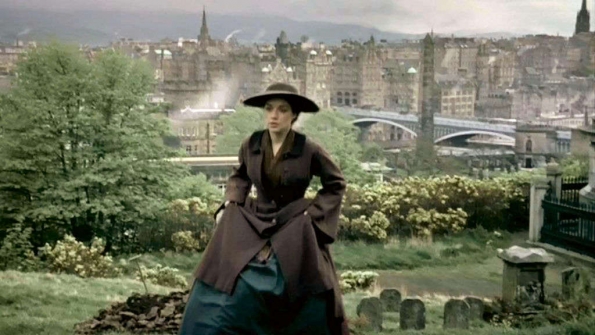 heir lives and shapes their minds, convicts them when they do wrong, and helps them to move on. In the book, also, the reader gets a chance to see inside Margaret-- "Why did she say that?" "Why did she do what she did?" "How did she feel about this?" These questions are answered by glimpses into Margaret's thoughts that the movie chose not, or was unable, to show. The book also help the reader understand who Leonards is, why he was pursuing Frederick, and what Frederick did after he returned to Spain. In addition, several of the characters (though not all) are much more likeable in the book-- Margaret is not annoying like she sometimes is in the film, Thornton does not have such an explosive temper, even Mrs. Hale does not seem quite as obnoxiously fretful and sickly in the book.
At the same time, there are aspects of the movie that I think are better than the book (if I may be so bold to say the filmmakers im
 proved upon the original). The movie shows you the mills at work several times and alternates scenes between Margaret, Thornton, and Nicholas more frequently to help you know better what is happening on all sides. (In the book, one does not know about Marlborough Mill's financial troubles or Thornton's and Nicholas' friendship until nearly the last chapter, or only by hearsay through letters that Margaret receives.) The movie also gave more color to characters like Bessie and Fanny, and Nicholas is more likeable in the movie than in the book.
I would have to say that reading the book North and South helped me to enjoy the movie better, and I think both are best enjoyed together. You can read North and South on Gutenberg press or buy it off of Amazon; the miniseries is also available from Amazon or from your local Barnes and Noble Bookstore.
Wednesday, June 9, 2010
Eric Liddell: Pure Gold

Eric Liddell: Pure Gold is a stirring and detailed biography of the life of the Olympic Champion and missionary, Eric Liddell, who inspired the film Chariots of Fire. Written by David McCasland and published in 2001 by Discovery House Publishers, this book explores, in depth, the life and death of this extraordinary man of God.
Eric Henry Liddell was born in Tientsin, China, on January 16, 1902, to Scottish missionaries James and Mary Liddell. He lived with them there in China until he was six years old, when his parents enrolled him and his brother Robert at Eltham College of Blackheath, England, a boarding school for missionaries' children. His parents left them there and returned to China with his younger sister, Jenny.
While at Eltham, and later at Edinburgh University, where he went for a BS in Pure Science, Eric became noted for his athletic skill and sportsmanship. As Eric excelled in rugby and running, he made his way to running in the 1924 Paris Olympics, where his faith and strength of principle would be tested and where he would become a renowned British champion.
This is as much as most people know of Eric Liddell's life, mainly because of the 1981 film, Chariots of Fire. However, Eric's life was much more than that of an Olympic runner. David McCasland looks deeply into Eric's life after he ret urned to the land of his birth, China, and into his ministry there in the Anglo-Chinese College of Tientsin, his love for his wife and daughters, and his last days in the Japanese prison camp at Weihsien during World War II. The real Eric Liddell, his love for God, his humility, his patience, his giving spirit, come to life in the pages of this book.
 urned to the land of his birth, China, and into his ministry there in the Anglo-Chinese College of Tientsin, his love for his wife and daughters, and his last days in the Japanese prison camp at Weihsien during World War II. The real Eric Liddell, his love for God, his humility, his patience, his giving spirit, come to life in the pages of this book.
The author put a great deal of study into the writing of this biography. While his writing style isn't the best I have read (I've been spoiled by Courtney Anderson ;-) ), his diligence and accurate portrayal of the life of my favorite missionary hero makes this book one of the best I have read. He interviewed a great many people who knew Eric and studied and quoted many letters, personal memoirs, newspapers, and so on; he also includes, in the latter part of the book, a great many excerpts of Eric Liddell's writings which really hit home. Some of these quotes can be found here. In addition, the book contains sixteen pages of photographs of Eric Liddell, his family, and his colleagues.
Eric Liddell was truly an amazing man. Many people remember Eric for his athletic reputation. However, the young people that he taug ht and befriended at Weihsien remembered him for his deep love for the Lord and his godly influence. They remembered him not only teaching on the Sermon on the Mount and the Love Chapter (1 Corinthians 13), but also living it out in his daily life. To read of his relationship with God causes me to ponder my own walk, and desire to be more like him, for he was like Christ. Eric ran his race through life well; his life-- and his death-- impacted so many people, and continues to impact people today-- myself included. I hope you will take the time to search this book out and read it for yourself. Let your life be impacted to by this humble man of God.
 ht and befriended at Weihsien remembered him for his deep love for the Lord and his godly influence. They remembered him not only teaching on the Sermon on the Mount and the Love Chapter (1 Corinthians 13), but also living it out in his daily life. To read of his relationship with God causes me to ponder my own walk, and desire to be more like him, for he was like Christ. Eric ran his race through life well; his life-- and his death-- impacted so many people, and continues to impact people today-- myself included. I hope you will take the time to search this book out and read it for yourself. Let your life be impacted to by this humble man of God.
“Wherefore seeing we also are compassed about with so great a cloud of witnesses,
let us lay aside every weight, and the sin which doth so easily beset us,
and let us run with patience the race that is set before us,
let us lay aside every weight, and the sin which doth so easily beset us,
and let us run with patience the race that is set before us,
Looking unto Jesus the author and finisher of our faith...” Hebrews 12:1,2
Monday, April 5, 2010
The Laird's Inheritance

The Laird's Inheritance, written by George MacDonald, was originally entitled Warlock o' Glenwarlock, and soon after changed to Castle Warlock. It was first published in 1881, and was one of MacDonald's longest novels, at 714 pages! In the 1987, it was edited by Michael Phillips and reprinted by Bethany House Publishers.
The description on the back of the book reads:
-------------------------------
A MYSTERIOUS DEATH IN THE FAMILY,
LEGENDS SURROUND THE CASTLE, A
MYSTERIOUS OLD POEM, AND UNEXPECTED
ROMANCE--WELL-CRAFTED FICTION
COMBINED WITH SPIRITUAL TRUTH TO
MAKE AN UNFORGETTABLE STORY!
Beautifully set in the proud culture of the Scottish Highlands, The Laird's Inheritance introduced the readers to a young boy, Cosmo Warlock, the last in a long line of landowning "lairds" of the Castle Warlock. His family once wealthy, Cosmo now grows up in poverty as piece after piece of the Laird's land is sold or mortgaged away to keep the creditors at bay.
This moving account of the loss of an earthly inheritance has become a vivid word portrait from the pen of Scotland's master storyteller to display the eternal inheritance of a heavenly kingdom.
-------------------------------
As is the case with all MacDonald's books, The Laird's Inheritance served as more than mere entertainment for me, though the story is indeed compelling and enjoyable. More than that, however, it etched its way deep into my heart, shining light upon the areas of my life that needed to change, and encouraging me on to a deeper walk with the Lord. It challenged me, in particular, to not allow any earthly thing to come in between me and God, but to allow Him to be the most important treasure in my life. The laird's conversations with his son were especially convicting and challenging, as he encourages Cosmo to set his heart upon God and his mind on things above, to "do justice, to love mercy, and to walk humbly with his God."
I had a very few quibbles with the book. Cosmo's character at the beginning was, to me, a little bit annoying, as it was very much like several of George MacDonald's other heroes, and as the story went on and he grew older, his personality began to grow on me and I liked him a lot better. The storywriter in me also could see ways that the story might have come together a little better so that the storylines ran more parallel and built on each other more. This is just a petty little opinion of mine though. :-) The Scottish dialogue has been slightly "toned down" to make it easier to read, though in some places I had to slow down and glance back at the introduction a couple times to get the right sense of what was being said.
Overall, it was a wonderful book, though. The story was engaging, the spiritual message was convicting, and I was reminded of why I love George MacDonald so much! I highly encourage you to get a copy of this book from your library or from Amazon.com. You can also read the original, unabridged version at Gutenberg.org.
I had a very few quibbles with the book. Cosmo's character at the beginning was, to me, a little bit annoying, as it was very much like several of George MacDonald's other heroes, and as the story went on and he grew older, his personality began to grow on me and I liked him a lot better. The storywriter in me also could see ways that the story might have come together a little better so that the storylines ran more parallel and built on each other more. This is just a petty little opinion of mine though. :-) The Scottish dialogue has been slightly "toned down" to make it easier to read, though in some places I had to slow down and glance back at the introduction a couple times to get the right sense of what was being said.
Overall, it was a wonderful book, though. The story was engaging, the spiritual message was convicting, and I was reminded of why I love George MacDonald so much! I highly encourage you to get a copy of this book from your library or from Amazon.com. You can also read the original, unabridged version at Gutenberg.org.
Tuesday, February 23, 2010
Gold Cord
 "The Dohnavur Fellowship is a group of Indian and European men and women who work together in the South of India. Its friends wanted to know how it began and they asked for something that would link up the stories already written; the beads should be strung on some sort of cord, they said. Others asked for another kind of cord. "What holds you together?" they asked; and we answered, "A gold cord."
Thus came the inspiration for Amy Carmichael's book, Gold Cord. This book, originally published in 1932 in the middle of Amy Carmichael's ministry, has been republished by Christian Literature Crusade and is available through many Christian book catalogues.
This book recounts the beginning and the growth of the Dohnavur Fellowship of India. It's foundation was "gold, silver, and precious stones" (chapter 1). God used that verse and many others to encourage Amy to commit her life to service for the Lord. An encounter with a runaway temple girl named Pearleyes made Amy and her fellow workers aware of the atrocities done to children in the Hindu temples of India, and launched their mission to rescue children from the temples and dramas of Southern India. As the fellowship struggled to grow, the Lord brought them through deep lessons to teach them to trust Him completely, and over and over again He showed them His power and grace in amazing ways.
Gold Cord is much more than such a collection of stories. It is a display of the grace of God and an amazing challenge to the readers to seek God with their whole hearts. In Miss Carmichael's words, "we are not here...for trivial purposes. We are here to prove to angels and to men
That life is not as idle ore,
But iron dug from central gloom,
And heated hot with burning fears
And dipped in baths of hissing tears,
And battered with the shocks of doom
To shape and use.
But iron dug from central gloom,
And heated hot with burning fears
And dipped in baths of hissing tears,
And battered with the shocks of doom
To shape and use.
"We are not here to be overcome, but to rise unvanquished after every knockout blow, and laugh the laugh of faith, not fear." She also reminds us, in the words of another author, "It matters nothing at all what we are, provided we are entirely willing to be made the instruments of His will, His agents in this world. I do not think we know the meaning of the word strength until we have fathomed our utter weakness." Through recounts of times that God intervened and answered prayers and blessed, Miss Carmichael shows to us the struggles and yet the subsequent joys of Christian life, the blessing of knowing Christ, and the importance of reaching others for Him, to give as Jesus gave, "holding nothing back".
This is no lazy read. It took me several months to read through it, as I preferred to take only one or two chapters at a time to let her words sink in. I must say, as I have read, I have been so challenged and encouraged to not live a complaisant life. Our time on earth is too short and too trivial to live for, but that which is done for Christ will last, the "gold, silver, and precious stones"-- those are the works that will abide.
If you are seeking a deeper relationship with Jesus and desiring to "climb" in your walk with Him, read Gold Cord! If you are happy with the way you are and aren't interested in being told to move forward in your walk with Christ, well, you might not be interested.
This is no lazy read. It took me several months to read through it, as I preferred to take only one or two chapters at a time to let her words sink in. I must say, as I have read, I have been so challenged and encouraged to not live a complaisant life. Our time on earth is too short and too trivial to live for, but that which is done for Christ will last, the "gold, silver, and precious stones"-- those are the works that will abide.
If you are seeking a deeper relationship with Jesus and desiring to "climb" in your walk with Him, read Gold Cord! If you are happy with the way you are and aren't interested in being told to move forward in your walk with Christ, well, you might not be interested.
Tuesday, February 2, 2010
Meet Rebecca
With the purchase of my Rebecca doll came the first book of her series. It is a children's book, but I decided to read it anyway!
Meet Rebecca introduces American Girl's newest character, Rebecca Rubin, who, according to American Girl's description, is "a lively girl with dramatic flair growing up in New York City" in 1914. Rebecca's parents and grandparents are Russian Jews who immigrated to America before she was born, but Rebecca's aunt, uncle, and cousins are still behind in Russia, where World War I is already underway.
Rebecca is the second to the youngest in her family, and often feels left out by her older siblings, who often treat her as though she is too young to include. Rebecca wants to prove herself to her family so she can be included in the more "grown-up" things as well. She comes up with a plan to earn money in order to buy her own candlesticks to light on Shabbos, to prove she is not so little and incapable.
However, when she finds out that her aunt, uncle, and cousins in Russia need money to escape to America, she begins to reevaluate her motives. Will she make the right choice between proving herself and helping her family? Will she find her rightful place in her family?
Meet Rebecca is a fun, well-written book carrying the flavor of the original American Girl books. At first I wasn't happy with Rebecca at all because she seemed so selfish, and I was annoyed by the typical "snobby older sisters" and "parents who don't understand" scenario. However, as the story moved along, I was glad to see Rebecca coming to realize the things that are more important in life.
The historical aspect of the story was also very interesting. Set in 1914, the book talks about the young days of the moving picture and also sheds some light on the difficulties the Jews faced in Russia during World War I. The Rubin family is Jewish, and the book talks a lot about their customs, particularly their observation of the Sabbath, though it doesn't get into the doctrine. I was pleased to read, in the "Looking Back" section, a mention of the Creation week (talking about God resting on the seventh day.) The theme of the story is also one that we should incorporate in our daily lives: looking beyond ourselves to do acts of kindness for others.
Overall, I was pretty pleased with the first book of the Rebecca Rubin series, and I am sure many young girls will enjoy reading them. It is only five chapters long and the writing style is very basic, so it will only take an hour or two to read through!
 to read it anyway!
Meet Rebecca introduces American Girl's newest character, Rebecca Rubin, who, according to American Girl's description, is "a lively girl with dramatic flair growing up in New York City" in 1914. Rebecca's parents and grandparents are Russian Jews who immigrated to America before she was born, but Rebecca's aunt, uncle, and cousins are still behind in Russia, where World War I is already underway.
Rebecca is the second to the youngest in her family, and often feels left out by her older siblings, who often treat her as though she is too young to include. Rebecca wants to prove herself to her family so she can be included in the more "grown-up" things as well. She comes up with a plan to earn money in order to buy her own candlesticks to light on Shabbos, to prove she is not so little and incapable.
However, when she finds out that her aunt, uncle, and cousins in Russia need money to escape to America, she begins to reevaluate her motives. Will she make the right choice between proving herself and helping her family? Will she find her rightful place in her family?
Meet Rebecca is a fun, well-written book carrying the flavor of the original American Girl books. At first I wasn't happy with Rebecca at all because she seemed so selfish, and I was annoyed by the typical "snobby older sisters" and "parents who don't understand" scenario. However, as the story moved along, I was glad to see Rebecca coming to realize the things that are more important in life.
The historical aspect of the story was also very interesting. Set in 1914, the book talks about the young days of the moving picture and also sheds some light on the difficulties the Jews faced in Russia during World War I. The Rubin family is Jewish, and the book talks a lot about their customs, particularly their observation of the Sabbath, though it doesn't get into the doctrine. I was pleased to read, in the "Looking Back" section, a mention of the Creation week (talking about God resting on the seventh day.) The theme of the story is also one that we should incorporate in our daily lives: looking beyond ourselves to do acts of kindness for others.
Overall, I was pretty pleased with the first book of the Rebecca Rubin series, and I am sure many young girls will enjoy reading them. It is only five chapters long and the writing style is very basic, so it will only take an hour or two to read through!
Thursday, January 21, 2010
Prisoners of the Sea
 From the author of the famed novel, Titus: Comrade of the Cross, comes a tale of adventure, mystery, and romance at the end of the 17th century. Prisoners of the Sea, by Florence Kingsley, has only recently been brought back into print by Lamplighter Publishing as part of their Rare Collectors Series.
King Louis XIV is upon the throne of France. He has declared Protestantism illegal, causing many Protestants, such as the Huguenots, to flee rance for Great Britain, the Netherlands, Germany, and even the New World. Among these refugees are Madame de Langres and her charming daughter Madeline, as well as young Henri Baillot, Comte de Lantenac.
However, a fierce storm finds these three, a rough, weather-beaten sailor named Winters, and a black man named Cato stranded in the middle of the ocean with no knowledge of their surroundings. A providential encounter with a deserted pleasure yacht results in the discovery of a mysterious island that appears to have been abandoned suddenly and inexplicably. They find a great castle, richly furnished, but no sign of life or hint of their whereabouts.
This is only the beginning of their adventures. When Baillot is mistakenly kidnapped in the middle of the night and spirited away from his companions, a series of strange and exciting events begins. Baillot must wade through mishaps and misunderstandings to rescue his friends and the woman he loves, while the rest struggle for survival on the mysterious island. They will face pirates, convicts, hunger, and adventure, while their paths will cross over one of the greatest mysteries of their time. Will Baillot and his friends ever be reunited, or will fate and danger separate them forever? Will they ever unfold the mysteries of the island or find their way to freedom in America?
Prisoners of the Sea contains a wonderful array of beautifully crafted characters. Baillot is definitely a classical hero, with his determination, faith, and unwavering love. The incorrigible sailor, Jack Winters, comes close behind Baillot in my list of favorite characters. His sense of humor is delightful, as is his childlike faith that develops towards the end of the book. Madeline, though a somewhat stereotypical 19th-century heroine, is so sweet, and her constancy and goodness make for a beautiful model. Kingsley also presents some wonderful "bad guys" that you absolutely hate and yet feel sorry for at the same time.
Overall, this book was a fantastic read that I wouldn't mind experiencing again! I spent some very fun afternoon hours with my coffee mug and Henri Baillot. The story was exciting in itself, but the very way that Florence Kingsley puts it in words makes it even more thrilling. Her descriptions are imaginative and picturesque, often making me feel like I was there and could see it for myself. She also bounces back and forth between Baillot's and Madeline's storylines in such a way that always kept me at the edge of my seat, usually switching settings at a very exciting part. The historical twist at the end is also fascinating-- so fascinating, in fact, that I decided to look it up online and found myself entranced in the mystery that is historically unsolved to this day.
Prisoners of the Sea is not laced and empowered with deep spiritual content like George MacDonald's books, but it is an interesting and inspiring portrayal of the faith of the Huguenots of the late 17th century, especially as the story occurs as a result of the Christian's pursuit of freedom of religion in the New World. The Christian characters display steadfast faith in God and love even to their enemies.
Those of you who enjoy a good adventure written in delightful style will love Prisoners of the Sea. It is a wonderful read for a winter day, and one which you hate to put down!
Tuesday, October 6, 2009
Hell's Best Kept Secret
Recently the Lord began to impress me with the great need to share the Gospel with the lost. When He put an opportunity to witness right on my lap (via my laptop!), I realized I needed to know how to witness, where to start, what to say. The Lord led me to pick up my sister's copy of an amazing book, Hell's Best Kept Secret, written by Ray Comfort, evangelist, author, and host of the award-winning TV show, The Way of the Master.
In the preface, the author presents his reason for this book. Many people do not hear the Gospel because Christians are bound by fear of rejection or fear of saying the wrong thing. In addition, many people think they are saved because they have been reached by a false Gospel under the name of Christianity. The purpose of Hell's Best Kept Secret is to break away from the present-day, faulty evangelistic fads and to return to "the way of the Master", the way that Jesus and Peter and Paul evangelized in the Bible. Ray also desires to give answers to frustrated Christians who are unsure of how to witness, and to inspire them to go forward for Christ's kingdom with fresh zeal.
Ray begins explaining the errors in modern-day "evangelism". Instead of giving a Gospel that calls people to repentance and surrender to God, people today advocate a man-centered Gospel. They say things like, "God loves you and has a wonderful plan for your life!" "Jesus will make you happy!" The Gospel becomes "a ticket out of hell" and allows people to continue to do whatever they wish with their lives. In most of the great evangelical campaigns, quite often less than 20% of the people who have professed salvation have stayed true and shown fruit of salvation. What has gone wrong? Is the Gospel less powerful today than it was in the days of Paul?
By no means! Ray Comfort reveals the major element missing in the popular Gospel presentation today: the Law. He explains, by Scripture and through colorful illustrations, that unless a person realizes their spiritual destitution and their need for God, they cannot experience true salvation.
Scripture sheds light on the function of the Law. The Law can never save anyone, and yet it is needful for a person to see their need for salvation. The Law (1) convicts of sin (Acts 24:24-25), (2) produces understanding (Hosea 4:6, Matthew 13:23), (3) builds faith (Romans 1:17, (4) exposes sin (Romans 7:7-8), (5) prepares the sinner to receive Christ (Luke 19:1-10), and (6) is the schoolmaster to bring us to Christ (Galatians 3:24). Drawing from Christ's encounter with the "Rich Young Ruler", Ray presents the principle of using the 10 Commandments in witnesses to convict the sinner of his sin and of his need for God. Based off of the account of the Samaritan woman at the well in John 4, he presents for principles to remember while witnessing to someone: (1) Relate (finding common interest, beginning a conversation), (2) Create (swing to a discussion of the Gospel), (3) Convict (help the person to see his need for God), and (4) Reveal (share with them how their sin can be forgiven and how they can have a personal relationship with God.)
In addition, the author answers questions such as, When and where should I engage in a spiritual conversation? How do I begin a spiritual conversation? When do I begin to talk about Jesus? How do I know a person has truly been saved? What do I say when a person has prayed for salvation? Can I be a witness for Christ? He also includes an eight-page appendix of additional frequently asked questions regarding witnessing, and answers to those questions.
This book was a great blessing and encouragement to me, as well as a huge motivator for me in sharing the Gospel. As well as helping me to know how to share Christ with others, it filled me with a fresh realization of my own sinfulness and a renewed appreciation and awe for the wonderful work Christ has done in me. After reading Hell's Best Kept Secret, I hope that I am now better equipped to take part in God's purpose for all believers: to disciple the nations. I highly recommend this book to those of you who desire to serve Christ with confidence and wisdom.
Hell's Best Kept Secret is copyrighted 1989 by Whitaker House and can be found at your local bookstore or at Living Waters. In addition, audio lessons, articles, and videos by Ray Comfort and his co-host Kirk Cameron regarding witnessing/evangelism can be found at The Way of the Master's website.
In the preface, the author presents his reason for this book. Many people do not hear the Gospel because Christians are bound by fear of rejection or fear of saying the wrong thing. In addition, many people think they are saved because they have been reached by a false Gospel under the name of Christianity. The purpose of Hell's Best Kept Secret is to break away from the present-day, faulty evangelistic fads and to return to "the way of the Master", the way that Jesus and Peter and Paul evangelized in the Bible. Ray also desires to give answers to
 frustrated Christians who are unsure of how to witness, and to inspire them to go forward for Christ's kingdom with fresh zeal.
Ray begins explaining the errors in modern-day "evangelism". Instead of giving a Gospel that calls people to repentance and surrender to God, people today advocate a man-centered Gospel. They say things like, "God loves you and has a wonderful plan for your life!" "Jesus will make you happy!" The Gospel becomes "a ticket out of hell" and allows people to continue to do whatever they wish with their lives. In most of the great evangelical campaigns, quite often less than 20% of the people who have professed salvation have stayed true and shown fruit of salvation. What has gone wrong? Is the Gospel less powerful today than it was in the days of Paul?
By no means! Ray Comfort reveals the major element missing in the popular Gospel presentation today: the Law. He explains, by Scripture and through colorful illustrations, that unless a person realizes their spiritual destitution and their need for God, they cannot experience true salvation.
Scripture sheds light on the function of the Law. The Law can never save anyone, and yet it is needful for a person to see their need for salvation. The Law (1) convicts of sin (Acts 24:24-25), (2) produces understanding (Hosea 4:6, Matthew 13:23), (3) builds faith (Romans 1:17, (4) exposes sin (Romans 7:7-8), (5) prepares the sinner to receive Christ (Luke 19:1-10), and (6) is the schoolmaster to bring us to Christ (Galatians 3:24). Drawing from Christ's encounter with the "Rich Young Ruler", Ray presents the principle of using the 10 Commandments in witnesses to convict the sinner of his sin and of his need for God. Based off of the account of the Samaritan woman at the well in John 4, he presents for principles to remember while witnessing to someone: (1) Relate (finding common interest, beginning a conversation), (2) Create (swing to a discussion of the Gospel), (3) Convict (help the person to see his need for God), and (4) Reveal (share with them how their sin can be forgiven and how they can have a personal relationship with God.)

In addition, the author answers questions such as, When and where should I engage in a spiritual conversation? How do I begin a spiritual conversation? When do I begin to talk about Jesus? How do I know a person has truly been saved? What do I say when a person has prayed for salvation? Can I be a witness for Christ? He also includes an eight-page appendix of additional frequently asked questions regarding witnessing, and answers to those questions.
This book was a great blessing and encouragement to me, as well as a huge motivator for me in sharing the Gospel. As well as helping me to know how to share Christ with others, it filled me with a fresh realization of my own sinfulness and a renewed appreciation and awe for the wonderful work Christ has done in me. After reading Hell's Best Kept Secret, I hope that I am now better equipped to take part in God's purpose for all believers: to disciple the nations. I highly recommend this book to those of you who desire to serve Christ with confidence and wisdom.
Hell's Best Kept Secret is copyrighted 1989 by Whitaker House and can be found at your local bookstore or at Living Waters. In addition, audio lessons, articles, and videos by Ray Comfort and his co-host Kirk Cameron regarding witnessing/evangelism can be found at The Way of the Master's website.
Wednesday, September 30, 2009
One Hundred and One Dalmatians (or, The Great Dog Robbery)
Cruella deVil, Cruella deVil,
If she doesn't scare you, no evil thing will!
The world was such a wholesome place until
Cruella, Cruella deVil!

Most of us know the song. Most of us know the story of how a family of fifteen puppies became a family of one hundred and one dalmatians. Most of us know Pongo and Perdita, Roger and Anita, and, of course, the famous fur-worshipper, Cruella, and her two cronies, Horace and Jasper.
But before 101 Dalmatians became a popular Disney film nearly fifty years ago, it was a book called The One Hundred and One Dalmatians, or, The Great Dog Robbery, published in 1956. The story, written by Dodie Smith, also ran in serial form in Woman's Day magazine.
Pongo and Missis, a Dalmatian couple, live with their "pets", Mr. and Mrs. Dearly, in London, and become the proud parents of fifteen busy little puppies. However, someone wants those puppies! Cruella deVil, a former schoolfriend of Mrs. Dearly's, loves fur coats, fur furniture, fur everything, and she is determined to have those puppies on her back one day. One day, the puppies disappear! Pongo suspects what has happened to them, and, through the cross-England canine gossip chain, the Twilight Bark, discovers that they are held hostage at Hell Hall, Cruella deVil's house in Suffolk. So he and Missis set out on an adventure to rescue their puppies, only to discover that their rescue mission will be a little greater than they expected.
The book contains some features different from the cartoon movie, particularly in names. Roger and Anita are actually named Mr. and Mrs. Dearly. Pongo's wife's name is "Missis", while "Perdita" is another Dalmatian who acts as a foster mother for some of the puppies before they are stolen. Other characters are added, deleted, or altered in the film. However, I found the book as fun and delightful as the movie (though not so Disney-ish :-) ).
The author presents the story in such a lively way. She has the most amusing way of putting life through an imaginary dog perspective: the idea of owners being pets; of dogs communicating through different barks, thumpings of the tail, and the "Twilight Bark"; of dogs understanding human's language and trying to learn concepts such as "left" and "right"... Of course, I understand that dogs are not like humans (like we've been learning at Bible Institute: the thing that makes us different from animals is that we are made in God's image, with a mind, will, emotions, and the ability to choose between right and wrong and to have a relationship with our Creator), but the imaginary element of the story is charming nonetheless. Overall, it was a very enjoyable, 200-page book for a rainy day (or in my case, two rainy days! :-) )
If she doesn't scare you, no evil thing will!
The world was such a wholesome place until
Cruella, Cruella deVil!

Most of us know the song. Most of us know the story of how a family of fifteen puppies became a family of one hundred and one dalmatians. Most of us know Pongo and Perdita, Roger and Anita, and, of course, the famous fur-worshipper, Cruella, and her two cronies, Horace and Jasper.
But before 101 Dalmatians became a popular Disney film nearly fifty years ago, it was a book called The One Hundred and One Dalmatians, or, The Great Dog Robbery, published in 1956. The story, written by Dodie Smith, also ran in serial form in Woman's Day magazine.
Pongo and Missis, a Dalmatian couple, live with their "pets", Mr. and Mrs. Dearly, in London, and become the proud parents of fifteen busy little puppies. However, someone wants those puppies! Cruella deVil, a former schoolfriend of Mrs. Dearly's, loves fur coats, fur furniture, fur everything, and she is determined to have those puppies on her back one day. One day, the puppies disappear! Pongo suspects what has happened to them, and, through the cross-England canine gossip chain, the Twilight Bark, discovers that they are held hostage at Hell Hall, Cruella deVil's house in Suffolk. So he and Missis set out on an adventure to rescue their puppies, only to discover that their rescue mission will be a little greater than they expected.
The book contains some features different from the cartoon movie, particularly in names. Roger and Anita are actually named Mr. and Mrs. Dearly. Pongo's wife's name is "Missis", while "Perdita" is another Dalmatian who acts as a foster mother for some of the puppies before they are stolen. Other characters are added, deleted, or altered in the film. However, I found the book as fun and delightful as the movie (though not so Disney-ish :-) ).
The author presents the story in such a lively way. She has the most amusing way of putting life through an imaginary dog perspective: the idea of owners being pets; of dogs communicating through different barks, thumpings of the tail, and the "Twilight Bark"; of dogs understanding human's language and trying to learn concepts such as "left" and "right"... Of course, I understand that dogs are not like humans (like we've been learning at Bible Institute: the thing that makes us different from animals is that we are made in God's image, with a mind, will, emotions, and the ability to choose between right and wrong and to have a relationship with our Creator), but the imaginary element of the story is charming nonetheless. Overall, it was a very enjoyable, 200-page book for a rainy day (or in my case, two rainy days! :-) )
Friday, September 4, 2009
Treasure Island
For years my only knowledge of the famous book Treasure Island was the infamous "Muppet's Treasure Island"! I remembered the "big blue wet thing" and Benjamina/Miss Piggy.... but really didn't know the actual story, only that it existed! Then some young friends who are helping me with The Marquis' Daughter suggested that I read this classic novel for help with the pirates and ship themes. So I brought home their copy, deciding to see what was so famous about this book that I had heard of and never read.
Treasure Island is a swashbuckling sea adventure of an island of the same name as the book title. The book is told from the perspective of a young boy named Jim Hawkins, living in the mid-1700s. His story begins when a loud, harsh, mysterious, weather-beaten sailor moves into the Hawkins's inn by the sea. This man carries with him the key to the grand adventure-- a map to a remote island on which lies buried seven hundred thousand pounds worth of treasure. The map is discovered after the sailor's death, and Jim, Squire Trelawney, and Dr. Livesey set out on a mission to find the island and acquire the treasure. However, half of the the ship's crew organized for the mission are pirates who had traveled with the famous Captain Flint, the lead pirate who buried the treasure. At the head of the buccaneers is the famous pirate: clever and treacherous Long John Silver. The expedition soon becomes a case of mutiny and murder, turncoats and treachery as the two parties seek for mastery and treasure.
Not much can be said for a book that is already so well-known. I am more used to reading thought-provoking "deep reads" and closer-to-real-life tales, and would probably not put Treasure Island on my "Top Ten Favorite Books" list. However, I did enjoy the story overall, and enjoyed following Jim's exciting adventures. The fast-paced action, heart-pounding scenes, and interesting characters make for a fun, a-musing boy's adventure book, at any rate. Perhaps some time you might pull it off the shelf and read through it. It might not be "a book you'll never forget" but it will be an entertaining read while you're at it!
P.S. When you do, bear in mind that this is a totally different story from "Muppet's Treasure Island" and you might as well forget about Benjamina Gunn! :-P
Treasure Island is a swashbuckling sea adventure of an island of the same name as the book title. The book is told from the perspective of a young boy named Jim Hawkins, living in the mid-1700s. His story begins when a loud, harsh, mysterious, weather-beaten sailor moves into the Hawkins's inn by the sea. This man carries with him the key to the grand adventure-- a map to a remote island on which lies buried seven hundred thousand pounds worth of treasure. The map is discovered after the sailor's death, and Jim, Squire Trelawney, and Dr. Livesey set out on a mission to find the island and acquire the treasure. However, half of the the ship's crew organized for the mission are pirates who had traveled with the famous Captain Flint, the lead pirate who buried the treasure. At the head of the buccaneers is the famous pirate: clever and treacherous Long John Silver. The expedition soon becomes a case of mutiny and murder, turncoats and treachery as the two parties seek for mastery and treasure.
Not much can be said for a book that is already so well-known. I am more used to reading thought-provoking "deep reads" and closer-to-real-life tales, and would probably not put Treasure Island on my "Top Ten Favorite Books" list. However, I did enjoy the story overall, and enjoyed following Jim's exciting adventures. The fast-paced action, heart-pounding scenes, and interesting characters make for a fun, a-musing boy's adventure book, at any rate. Perhaps some time you might pull it off the shelf and read through it. It might not be "a book you'll never forget" but it will be an entertaining read while you're at it!
P.S. When you do, bear in mind that this is a totally different story from "Muppet's Treasure Island" and you might as well forget about Benjamina Gunn! :-P
Thursday, August 27, 2009
Bleak House
London. Michaelmas Term lately over, and the Lord Chancellor sitting in Lincoln's  Hall Inn.... Fog everywhere. Fog up the river... fog down the river... fog on the Essex marshes, fog on the Kentish heights... The raw afternoon is rawest,and the dense fog is densest, and the muddy streets are muddiest, near the laden-headed old obstruction, appropriate ornament for the threshold of a leaden-headed old corporation: Temple Bar. And hard by Temple Bar, in Lincoln's Hall Inn, at the very heart of the fog, sits the Lord High Chancellor in His High Court of Chancery.
Thus begins Charles Dickens' epic tale of the long-standing Chancery court case of disputed wills, dashed hopes, and damaged lives. Bleak House was originally published, over the course of nineteen months, in a magazine, Household Words, and was printed in volume form in 1853. It has remained a stirring classic ever since, and has been made by BBC into a phenomenal, 15-episode miniseries.
At the very heart of the fog stands the High Court of Chancery. At the heart of Bleak House lies the "monument of Chancery practice"-- Jarndyce and Jarndyce-- a 53-year-old case of several wills upon which no one can agree. And at the heart of Jarndyce and Jarndyce stand cousins Richard Carstone and Ada Clare, taken in by a distant cousin, Mr. John Jarndyce, one of the kindest and most benevolent ficti onal characters of Dickens' creation. A young lady of obscure birth, Esther Summerson, also finds herself drawn into the confusing case when called upon as a companion for Ada. Against Mr. Jarndyce's recommendation, Richard throws himself into the pursuit of his interests in the Chancery case, while Esther searches to know her hidden ancestory.
According to his own distinctive style, Dickens builds his plot around a wide variety of places, people, and circumstances. We find ourselves familiar with the depressed slum, Tom-All-Alone's; the great Lincolnshire house, Chesney Wold; the center of despair and misery, Lincoln's Hall Inn; and the cheerful haven, the house oddly enough called Bleak House, after which the book is named. We grow to love-- or hate-- Dickens' colorful characters: ice-cold Lady Dedlock with her haunted past; the hilarious clerk Mr. Guppy and "the image imprinted on his 'art"; the clever, indefatigable sleuth, Mr. Bucket (said to be one of British Literature's earliest detectives); the evil, prying, power-obsessed lawyer, Tulkinghorn; preoccupied Mrs. Jellaby and her Borrioboola-Gha project; the poor, illiterate crossing-sweeper boy, Jo; the eccentric but endearing Miss Flite, who looks forward to the "Day of Judgment" when all her little birds will be set free; the crooked, self-serving free-loader Skimpole... Rising above them are some of my favorite fictional characters ever: Esther Summerson, whose sweet humility, constant love, and selfless service are a model of a godly woman; and Alan Woodcourt, a doctor whose life is marked by Christlike character and unswerving love and compassion.
Dickens also mixes a huge variety of genres, as only Dickens can do; in Bleak House, we find the legal thriller, mystery, romance, tragedy, adventure, and satire. We see philanthropy and poverty, secret pasts and scandal, comedy and crime, and the undying virtues of love, humility, generosity, and true righteousness.
While Bleak House features a phenomenal storyline and cast, it requires a determined reader who is willing to undertake eight hundred pages of Dickens' very unique writing style which often consists of very long des criptions (for instance, nearly the whole first chapter describes the fog and the operations of the Court of Chancery, which I abbreviated at the beginning of this review) and confusing rabbit-trails (such as the discourse on Sir Leicester's political views in Chapter 28 and elsewhere). One of this novel's further singularities is that it alternates between two narrators: an unnamed narrator who writes in third person and in present tense, and Esther Summerson, who writes in first person and past tense. While at the same time entertaining, it can also be confusing and does disallow the interchange of scenes from all points of view. These challenges are gladly overlooked, however, in light of a wonderful, heart-stirring story.
When Dickens wrote this novel, the Court of Chancery was just as real, as controlling, and as ruinous as it appears to be in the story. At the time of writing, a suit stood before the court which had commenced nearly twenty years earlier, the costs of which had amounted to seventy thousand pounds (according the author's Preface, page 5). In addition, Dickens saw all around him the poverty and despair of places much like Tom-All-Alone's and of people much like Jo, the crossing-sweeper. Like Dickens' other novels, Bleak House shows life as it really was an d is: it is not a bed of roses or a rag-to-riches existence; there are the very wealthy and there are the unbelievable poor; there are righteous people who choose to bless each life they touch, and there are cruel people who are determined to control or ruin the lives of everyone around them; there are the wrongs of this world, and there is "the world that sets this [world] right." Bleak House met with a society in desperate need of reform, and indeed, it succeeded in causing its readers, then and now, to consider what is important in life. I highly suggest you put this book on your list for winter reads. It is an adventure you will never forget.
For those who are still wary of undertaking the reading of such a long book, or who simply enjoy a good film adaption of a classic work, I recommend BBC's outstanding television adaption of Bleak House. With a screenplay written by Andrew Davies (Pride and Prejudice, Wives and Daughters), this phenomenal miniser ies runs over 450 minutes and features stunning cinema- tography, a thrilling music score, and a star- studded cast which includes Gillian Anderson (PBS's Masterpiece Theater), Anna Maxwell Martin (North and South), and Carey Mulligan (Pride and Prejudice 2005). Guppy is absolutely slapstick hilarious; and Tulkinghorn's puffy eyes, low voice, and sinister looks are perfectly done. This adaption mixes and matches some of the scenes for a better and more understandable flow of the story line, and eliminates some of the unimportant events and characters (such as Mrs. Snagsby's suspicion of her husband regarding Jo, and the silly, painted cousin of the Dedlocks, Volumnia.) The book, however, sheds more light on some details, particularly on backgrounds and thoughts that are hard to express on film. Overall, it is an excellent adaption of an excellent story and I recommend it as highly as I do the book.
 Hall Inn.... Fog everywhere. Fog up the river... fog down the river... fog on the Essex marshes, fog on the Kentish heights... The raw afternoon is rawest,and the dense fog is densest, and the muddy streets are muddiest, near the laden-headed old obstruction, appropriate ornament for the threshold of a leaden-headed old corporation: Temple Bar. And hard by Temple Bar, in Lincoln's Hall Inn, at the very heart of the fog, sits the Lord High Chancellor in His High Court of Chancery.
Thus begins Charles Dickens' epic tale of the long-standing Chancery court case of disputed wills, dashed hopes, and damaged lives. Bleak House was originally published, over the course of nineteen months, in a magazine, Household Words, and was printed in volume form in 1853. It has remained a stirring classic ever since, and has been made by BBC into a phenomenal, 15-episode miniseries.
At the very heart of the fog stands the High Court of Chancery. At the heart of Bleak House lies the "monument of Chancery practice"-- Jarndyce and Jarndyce-- a 53-year-old case of several wills upon which no one can agree. And at the heart of Jarndyce and Jarndyce stand cousins Richard Carstone and Ada Clare, taken in by a distant cousin, Mr. John Jarndyce, one of the kindest and most benevolent ficti
 onal characters of Dickens' creation. A young lady of obscure birth, Esther Summerson, also finds herself drawn into the confusing case when called upon as a companion for Ada. Against Mr. Jarndyce's recommendation, Richard throws himself into the pursuit of his interests in the Chancery case, while Esther searches to know her hidden ancestory.
According to his own distinctive style, Dickens builds his plot around a wide variety of places, people, and circumstances. We find ourselves familiar with the depressed slum, Tom-All-Alone's; the great Lincolnshire house, Chesney Wold; the center of despair and misery, Lincoln's Hall Inn; and the cheerful haven, the house oddly enough called Bleak House, after which the book is named. We grow to love-- or hate-- Dickens' colorful characters: ice-cold Lady Dedlock with her haunted past; the hilarious clerk Mr. Guppy and "the image imprinted on his 'art"; the clever, indefatigable sleuth, Mr. Bucket (said to be one of British Literature's earliest detectives); the evil, prying, power-obsessed lawyer, Tulkinghorn; preoccupied Mrs. Jellaby and her
 Borrioboola-Gha project; the poor, illiterate crossing-sweeper boy, Jo; the eccentric but endearing Miss Flite, who looks forward to the "Day of Judgment" when all her little birds will be set free; the crooked, self-serving free-loader Skimpole... Rising above them are some of my favorite fictional characters ever: Esther Summerson, whose sweet humility, constant love, and selfless service are a model of a godly woman; and Alan Woodcourt, a doctor whose life is marked by Christlike character and unswerving love and compassion.
Dickens also mixes a huge variety of genres, as only Dickens can do; in Bleak House, we find the legal thriller, mystery, romance, tragedy, adventure, and satire. We see philanthropy and poverty, secret pasts and scandal, comedy and crime, and the undying virtues of love, humility, generosity, and true righteousness.
While Bleak House features a phenomenal storyline and cast, it requires a determined reader who is willing to undertake eight hundred pages of Dickens' very unique writing style which often consists of very long des
 criptions (for instance, nearly the whole first chapter describes the fog and the operations of the Court of Chancery, which I abbreviated at the beginning of this review) and confusing rabbit-trails (such as the discourse on Sir Leicester's political views in Chapter 28 and elsewhere). One of this novel's further singularities is that it alternates between two narrators: an unnamed narrator who writes in third person and in present tense, and Esther Summerson, who writes in first person and past tense. While at the same time entertaining, it can also be confusing and does disallow the interchange of scenes from all points of view. These challenges are gladly overlooked, however, in light of a wonderful, heart-stirring story.
When Dickens wrote this novel, the Court of Chancery was just as real, as controlling, and as ruinous as it appears to be in the story. At the time of writing, a suit stood before the court which had commenced nearly twenty years earlier, the costs of which had amounted to seventy thousand pounds (according the author's Preface, page 5). In addition, Dickens saw all around him the poverty and despair of places much like Tom-All-Alone's and of people much like Jo, the crossing-sweeper. Like Dickens' other novels, Bleak House shows life as it really was an
 d is: it is not a bed of roses or a rag-to-riches existence; there are the very wealthy and there are the unbelievable poor; there are righteous people who choose to bless each life they touch, and there are cruel people who are determined to control or ruin the lives of everyone around them; there are the wrongs of this world, and there is "the world that sets this [world] right." Bleak House met with a society in desperate need of reform, and indeed, it succeeded in causing its readers, then and now, to consider what is important in life. I highly suggest you put this book on your list for winter reads. It is an adventure you will never forget.
~*~*~*~*~*~
For those who are still wary of undertaking the reading of such a long book, or who simply enjoy a good film adaption of a classic work, I recommend BBC's outstanding television adaption of Bleak House. With a screenplay written by Andrew Davies (Pride and Prejudice, Wives and Daughters), this phenomenal miniser
 ies runs over 450 minutes and features stunning cinema- tography, a thrilling music score, and a star- studded cast which includes Gillian Anderson (PBS's Masterpiece Theater), Anna Maxwell Martin (North and South), and Carey Mulligan (Pride and Prejudice 2005). Guppy is absolutely slapstick hilarious; and Tulkinghorn's puffy eyes, low voice, and sinister looks are perfectly done. This adaption mixes and matches some of the scenes for a better and more understandable flow of the story line, and eliminates some of the unimportant events and characters (such as Mrs. Snagsby's suspicion of her husband regarding Jo, and the silly, painted cousin of the Dedlocks, Volumnia.) The book, however, sheds more light on some details, particularly on backgrounds and thoughts that are hard to express on film. Overall, it is an excellent adaption of an excellent story and I recommend it as highly as I do the book.
Subscribe to:
Posts (Atom)